
Peteĩ po kyrĩgue mboraei: Musical Analysis of Five Mbya-Guarani Chants
DOI:
https://doi.org/10.20504/opus2019b2503Keywords:
Kyrĩgue mboraei, Mbya-Guarani music, Ethnomusicology, musical analysis.Abstract
This article aims to identify the patterns and particularities found in five indigenous Mbya-Guarani chants. These chants, mboraei, are part of the mborai kyrĩgue, a modality of the music repertoire of the Mbya-Guarani people from the Tenonde Porã village, located in the south of São Paulo, SP, Brazil. The author learned these chants between the years 2013 and 2015 during a master’s research project. This article analyzes each one of the selected mboraei through pitch-set class theory, starting with a brief consideration about the transcription of the songs shared during the ethnomusicological work and about the Mbya-Guarani compositional processes.References
ARNT, Monica de Andrade. Mediações musicais e direitos autorais entre grupos Mbyá-Guarani no Rio Grande do Sul. Dissertação (Mestrado em Antropologia Social). Instituto de Filosofia e Ciências Humanas, Universidade Federal do Rio Grande do Sul, Porto Alegre, 2010.
CAMPBELL, Patricia Shehan. How Musical we are: John Blacking on Music, Education, and Culture Understanding. Journal of Research in Music Education, v. 48, n. 4, p. 336-359, 2000.
______. Ethnomusicology and Music Education: Crossroads for Knowing Music, Education, and Culture. Research Studies in Music Education, v. 21, n. 1, p. 16-30, 2003.
DOOLEY, Robert A. (Organização, compilação e assistência linguística). Léxico Guarani, dialeto mbya: versão para fins acadêmicos. Porto Velho: Sociedade Internacional de Linguística, revisão de novembro de 1998.
FRAGOSO, Daisy. Educação musical e diversidade – uma experiência entre crianças Guarani Mbya e crianças não indígenas. In: JORNADA DE ESTUDOS EM EDUCAÇÃO MUSICAL, 5., 2015. São Carlos. Anais... São Carlos: UFSCar, 2015a. p. 48-58.
______. Entre a opy e a sala de música: arranjos entre crianças guarani Mbya e crianças não indígenas. Dissertação (Mestrado). Escola de Comunicações e Artes, Universidade de São Paulo, São Paulo, 2015b.
______. A infância e o processo de ensino-aprendizagem entre os Guarani Mbya: jogo, música e educação. Orfeu, Florianópolis, v. 2, n. 2, p. 31-44, dez. 2017. Disponível em: <http://www.revistas.udesc.br/index.php/orfeu/article/view/1059652525530402022017031/7416>. Acesso em: 30 dez. 2018
______. Interlocuções entre a Etnomusicologia e a Educação Musical. Revista Música – Programa de Pós-Graduação em Música da Escola de Comunicações e Artes da Universidade de São Paulo, v. 18, n. 1, 2018. Disponível em: <http://www.revistas.usp.br/revistamusica/article/view/145698/146547>. Acesso em: 20 nov. 2018.
HARROP-ALLIN, Susan. Ethnomusicology and Music Education: Developing the Dialogue. South African Journal of Musicology – SAMUS, v. 25, p. 109-125, 2005.
HIGGINS, Lee; CAMPBELL, Patricia Sehan. Intersections Between Ethnomusicology, Music Education, and Community Music. In: PETTAN, Svanibor; TITON, Jeff T. The Oxford Handbook of Applied Ethnomusicology. Oxford: Oxford University Press, 2015.
MACEDO, Valeria. Nexos da diferença: cultura e afecção em uma aldeia guarani na Serra do Mar. Tese (Doutorado em Antropologia). Faculdade de Filosofia, Letras e Ciências Humanas, Universidade de São Paulo, São Paulo, 2009.
______. Tracking Guarani Songs. Between Villages, Cities and Worlds. Vibrant, Dossiê Música e Antropologia, [online], v. 8, n. 1, p. 377-410, 2011a. Disponível em: <http://www.scielo.br/pdf/vb/v8n1/a14v8n1.pdf>. Acesso em: 7 nov. 2018.
______. Vetores porã e vai na cosmopolítica Guarani. Tellus, Campo Grande, ano 11, n. 21, p. 25-52, jul./dez. 2011b. Disponível em: <http://www.tellus.ucdb.br/index.php/tellus/article/view/241/277>. Acesso em: 7 nov. 2018.
______. Dos cantos para o mundo. Invisibilidade, figurações da “cultura” e o se fazer ouvir nos corais guarani. Revista de Antropologia, São Paulo, v. 55, n. 1, p. 357-400, jan./jun. 2012. Disponível em: <http://www.revistas.usp.br/ra/article/view/46969/51314>. Acesso em: 7 nov. 2018.
______. De encontros nos corpos guarani. Ilha – Revista de Antropologia, UFSC, Santa Catarina, v. 15, n. 2, p. 181-210, jul./dez. 2013. Disponível em: <https://periodicos.ufsc.br/index.php/ilha/article/view/2175-8034.2013v15n1-2p180/26069>. Aesso em: 7 nov. 2018.
______. Misturar e circular em modulações guarani. Uma etnologia das (in)disposições. Mana, v. 23, n. 3, p. 511-543, 2017. Disponível em: <http://www.scielo.br/pdf/mana/v23n3/1678-4944-mana-23-03-511.pdf>. Acesso em: 7 nov. 2018.
MACEDO, Valeria; SZTUTMAN, Renato. A parte de que se é parte. Notas sobre individuação e divinização (a partir dos Guarani). Cadernos de Campo, São Paulo, n. 23, p. 287-302, 2014. Disponível em: <http://www.revistas.usp.br/cadernosdecampo/article/view/98492/pdf>. Acesso em: 8 nov. 2018.
MELO, Clarissa Rocha de. Uma escuta do mundo: processos de ensinar e aprender entre os Guarani. In: TASSINARI, Antonella Maria Imperatriz; GRANDO, Beleni Saléte; ALBUQUERQUE, Marcos Alexandre dos Santos (Orgs.). Educação indígena: reflexões sobre noções nativas de infância, aprendizagem e escolarização. Florianópolis: Editora da UFSC, 2012. p. 117-140.
MELLO, Maria Ignez Cruz. Aspectos interculturais da transcrição musical: análise de um canto indígena. Opus, v. 11, p. 221-236, dez. 2005. Disponível em: <https://www.anppom.com.br/revista/index.php/opus/article/view/530/449>. Acesso em: 30 ago. 2018.
MENEZES BASTOS, Rafael José de. A musicológica Kamayurá: para uma antropologia da comunicação no Alto-Xingu. Brasília: FUNAI, 1978.
______. A festa da Jaguatirica: uma partitura crítico-interpretativa. Tese (Doutorado em Antropologia Social). Faculdade de Filosofia, Letras e Ciências Humanas, Univerisdade de São Paulo, São Paulo, 1990.
MONTARDO, Deise Lucy Oliveira. Através do Mbaraka: música e xamamismo guarani. Tese (Doutorado em Antropologia Social). Faculdade de Filosofia, Letras e Ciências Humanas, Universidade de São Paulo, São Paulo, 2002.
______. Através do Mbaraka: música e xamamismo guarani. São Paulo: Edusp, 2009.
OLIVEIRA, Melissa Santanta de. Nhanhembo’é: infância, educação e religião entre os Guarani de M’Biguaçu, SC. In: TASSINARI, Antonella Maria Imperatriz; GRANDO, Beleni Saléte; ALBUQUERQUE, Marcos Alexandre dos Santos (Orgs.). Educação indígena: reflexões sobre noções nativas de infância, aprendizagem e escolarização. Florianópolis: Editora da UFSC, 2012. p. 93-116.
OLIVEIRA PINTO, Tiago de. Som e música: questões de uma antropologia sonora. Revista de Antropologia, USP, n. 1, v. 44, p. 221-286, 2001. Disponível em: <http://www.scielo.br/pdf/ra/v44n1/5345.pdf>. Acesso em: 20 nov. 2018.
PIEDADE, Acácio Tadeu de Camargo. O canto do Kawoká: música, cosmologia e filosofia entre os Wauja do Alto Xingu. Tese (Doutorado em Antropologia Social). Universidade Federal de Santa Catarina, Florianópolis, 2004.
PISSOLATO, Elizabeth de Paula. A duração da pessoa: mobilidade, parentesco e xamamismo mbya (guarani). São Paulo: Unesp/ISA; Rio de Janeiro: NUTI, 2007.
QUEIROZ, Luís Ricardo Silva. Educação musical e etnomusicologia: caminhos, fronteiras e diálogos. Opus, Goiânia, v. 16, n. 2, p. 113-130, dez. 2010. Disponível em: <http://www.anppom.com.br/revista/index.php/opus/article/view/221/201>. Acesso em: 20 nov. 2018.
SANTOS, Lucas Keese. A esquiva do Xondaro: movimento e ação política entre os Guarani-Mbya. Dissertação (Mestrado). Faculdade de Filosofia, Letras e Ciências Humanas, Universidade de São Paulo, 2016.
SCHADEN, Egon. Aspectos fundamentais da cultura guarani. São Paulo: EPU, Editora da Universidade de São Paulo, 1974.
SEEGER, Anthony. Why Suyá sing: A Musical Anthropology of Amazon People. Illinois: Illinois University, 1987.
STEIN, Marília Raquel Albornoz. Kyringüe mboraí: os cantos das crianças e a cosmo-sônica Mbyá-Guarani. Tese (Doutorado em Música). Universidade Federal do Rio Grande do Sul, Porto Alegre, 2009.
STRAUS, Joseph Nathan. Introdução à teoria pós-tonal. São Paulo: Editora da Unesp, 2012; Salvador: EDUFBA, 2013.
WAGNER, Roy. A invenção da cultura. São Paulo: Cosac Naify, 2012.
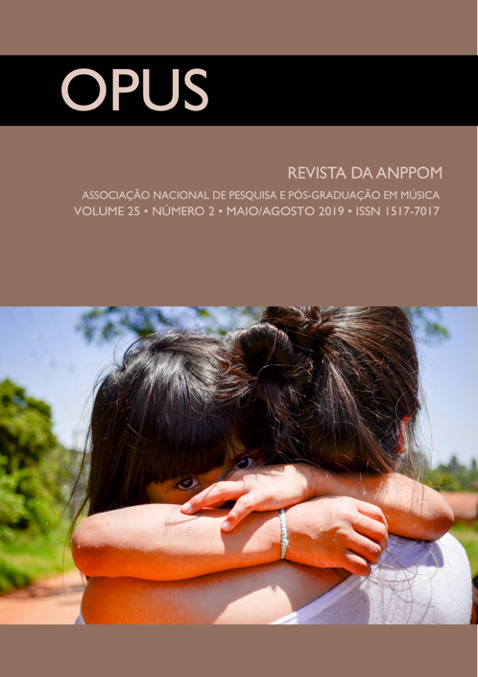
Downloads
Published
Issue
Section
License
Authors of articles published by Opus retain the copyright to their work, licensing it under the Creative Commons Attribution CC BY 4.0 license, which allows articles to be reused and distributed without restriction, as long as the original work is correctly cited.
Ethics and good publication practices
Opus adopts the guidelines of the Committee on Publication Ethics (COPE) and the Guidelines on Best Practices for Strengthening Ethics in Scientific Publication, by SciELO, as a reference, including issues related to conflicts of interest, plagiarism, manipulation of citations, dissemination of prejudicial opinions, among other. With these guidelines as a base, authors’ responsibilities include:
- To take full responsibility for the content of their paper;
- To participate in peer review process;
- To ensure that all co-authors have made significant contributions to the research, and that there is a full consensus of all co-authors in approving the final version of the paper and its submission for publication;
- To ensure that the manuscript has not been submitted to more than one publication at a time, and that the manuscript has not been published elsewhere;
- To ensure that any work or words of others authors, contributors or sources have been appropriately credited and referenced;
- To notify the journal editors if a significant error or inaccuracy in his/her published work is discovered, and cooperate with them to provide retractions or corrections;
- To be aware that plagiarism constitutes unethical publishing behaviour and is unacceptable.
Declaration of absence of conflict of interests
Everyone involved in the editorial process of a manuscript must communicate the existence of a conflict of interest.
Editors should avoid making decisions about manuscripts that conflict with their own interests, such as those submitted by authors in their department or research collaborators.
Considering the possibility of conflicts of interest, the journal does not publish articles authored by the journal's own editors.
If deputy editors have a conflict of interest, they must delegate decision-making to other editors.
Reviewers must consider any type of conflict of interest before evaluating the manuscript. Working relationships with the author must be considered (e.g.: participating or having participated in a research project; maintaining or having maintained scientific collaboration with research groups; having a mentoring relationship with the author; having a financial interest in the project involved in the manuscript).
