
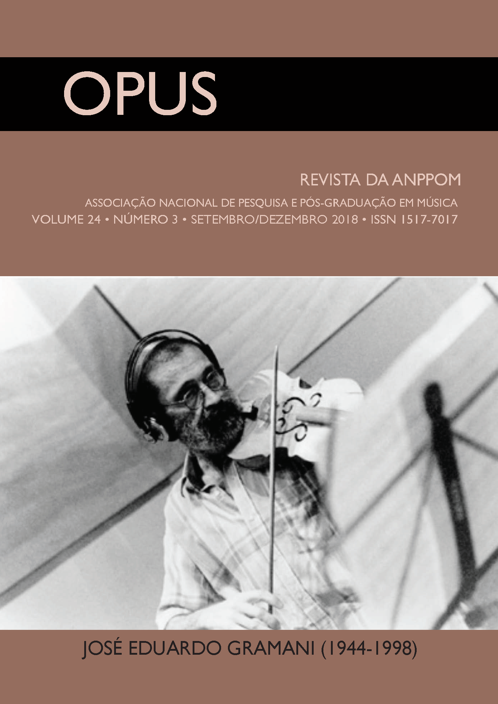
The Rhythmic (Anti-)Method of José Eduardo Gramani: A Proposal for the Balance Between the Sensorial and the Rational
DOI:
https://doi.org/10.20504/opus2018c2405Keywords:
José Eduardo Gramani, rhythmic, music cognition.Abstract
Using Stravinsky’s The Soldier's Tale as a model, this article analyzes Gramani’s study of rhythmic meter from a (anti-)method viewpoint and attempts to bring to light its implications beyond its origin founded on Stravinsky’s asymmetrical meter. We speculate on the work’s link to the principles of medieval Rhythmic Modes through additive rhythmic series; we relate it to its openness to non-European rhythmic precepts starting from the rhythmic lines based on cyclic ostinatos that more appropriately approach the concept of timeline revealed by African ethnomusicology; and we discuss the hypothesis that the division of attention and the multidirectional perception needed to execute the exercises structured by Gramani could induce the student to stimulate laterality and functional asymmetry of the hemispheres of the brain inherent to musical perception and to pass through the sensations derived from the “hemispherical modulation” of listening to and making music. It is a question of considering Gramani's rhythmic exercises as a path of equilibrium between the right (RH) and left (LH) hemispheres of the brain, a bridge between the rational and the sensorial, counting and feeling, a meeting point between reason and emotion, writing and sound phenomena. All these issues are pressing in music pedagogy and musical performance. Therefore, this article aims to discuss to what extent Gramani's (anti-)method acts as a point of equilibrium between the rational and the sensorial, and to reveal the musical and extra-musical implications that his rhythmic meter presents.References
AGAWU, Kofi. Structural Analysis or Cultural Analysis? Competing Perspectives on the “Standard Pattern” of West African Rhythm. Journal of the American Musicological Society, v. 59, n. 1, p. 1-46, 2006.
AROM, Simha. Polyphonies et polyrythmies instrumentales d’Afrique Centrale. Paris: Centre National de Recherche Scientifique, 1985.
BERGER, Anna Maria Busse. Medieval Music and the Art of Memory. Los Angeles: University of California Press, 2005.
BONFITTO, Matteo. O Ator-compositor. São Paulo: Editora Perspectiva, 2002.
COELHO, Marcelo Pereira. Suíte I Juca Pirama: criação de um sistema composicional a partir da adequação da polirritmia de José Eduardo Gramani ao jazz modal de Ron Miller. Tese (Doutorado em Música). Instituto de Artes, Universidade Estadual de Campinas, Campinas, 2008.
COOK, Nicholas. Analysing Performance and Performing Analiysis. In: COOK, N.; EVARIST, M. (Org.). Rethinking Music. Oxford: Oxford University Press, 2001. p. 239-261.
DIBBEN, Nicola. Musical Materials, Perception, and Listening. In: CLAYTON, Martin; HERBERT, Trevor; MIDDLETON, Richard. The Cultural Study of Music: A Critical Introduction. New York: Routledge, 2003. p. 193-203.
DONINGTON, Robert. Introduction. In: GEMINIANI, Francesco. A Treatise of Good Taste in th Art of Musick. New York: Da Capo Press, 1969.
DUARTE, Fernando José Carvalhaes. Sobre jogos e júbilos: o percurso de uma invocação. In: SEKEFF, Maria de L.; ZAMPRONHA, Edson (Orgs.). Arte e Cultura IV: estudos interdisciplinares. São Paulo: Annablume, 2006. p. 59-91.
FIAMINGHI, Luiz Henrique. O Violino Violado: rabeca, hibridismo e desvio do método nas práticas interpretativas contemporâneas – tradição e inovação em José Eduardo Gramani. Tese (Doutorado em Música). Instituto de Artes da Universidade Estadual de Campinas, Campinas, 2008.
FONSECA, Edilberto José de Macedo. O toque do gã: tipologia preliminar das linhas-guias do candomblé Ketu-nagô no Rio de Janeiro. Dissertação (Mestrado em Música Brasileira). Centro de Letras e Artes, Universidade do Rio de Janeiro, Rio de Janeiro, 2003.
FOUCAULT, Michel. Vigiar e punir: nascimento da prisão. Trad. R. Ramalhete. Petrópolis, RJ: Vozes, 2007.
GRAMANI, José Eduardo. Rítmica. São Paulo: Editora Perspectiva, 1988.
______. Rítmica viva: a consciência musical do ritmo. Campinas: Editora da Unicamp, 1996.
GUMBOSKI, Leandro. Os Novos Ritmos de Don Ellis: considerações analíticas e perceptivas. Dissertação (Mestrado em Música). Centro de Artes, Universidade do Estado de Santa Catarina, Florianópolis, 2014.
HARNONCOURT, Nikolaus. O discurso dos sons. Trad. Marcelo Fagerlande. Rio de Janeiro: Jorge Zahar Editor, 1994.
HOULE, George. Meter in Music, 1600-1800: Performance, Perception, and Notation. Bloomington, Indiana University Press, 1987.
KUBIK, Gerard. Angolan Traits in Black Music, Games and Dance of Brazil. Lisboa: Junta de Investigações Científicas do Ultramar, 1979.
KRUMHANSL, Carol L. Ritmo e altura na cognição musical. In: ILARI, Beatriz (Org.). Em busca da mente musical. Curitiba: Editora da UFPR, 2006. p. 45-109.
LACERDA, Marcos Branda. Música instrumental no Benim: repertório Fon e música Batá. São Paulo: Edusp, 2014.
LEMOS, Maya Suemi. Do tempo analógico ao tempo abstrato: a musica mensurata e a construção da temporalidade moderna. Estudos Históricos, Rio de Janeiro, n. 35, p. 159-175, 2005.
LERDAHL, Fred; JACKENDOFF, Ray. A Generative Theory of Tonal Music. Cambridge: Massachusetts Institute of Technology, 1983.
MARTINEZ, José Luiz. Ópera contemporânea e seus arredores – intersemiose e multimidialidade. In: SEKEFF, Maria de L.; ZAMPRONHA, Edson (Orgs.). Arte e Cultura IV: estudos interdisciplinares. São Paulo: Annablume, 2006. p. 15-50.
______. Cognição, pensamento e semiótica musical. In: SIMPÓSIO INTERNACIONAL DE COGNIÇÃO E ARTES MUSICAIS, I., 2005, Curitiba. Anais... Curitiba: De Artes, 2005. p. 78-81.
NATTIEZ, Jean Jacques. O combate entre Cronos e Orfeu. Ensaios de semiologia musical aplicada. Trad. Luiz Paulo Sampaio. São Paulo: Via Lettera Editora, 2005.
NKETIA, J. H. Kwabena. The Music of Africa. New York: Norton & Company Inc., 1974.
OLIVEIRA, José Zula de. Assimetria funcional dos hemisférios cerebrais na percepção de timbre, intensidade ou altura, em contexto musical. In: SIMPÓSIO DE COGNIÇÃO E ARTES MUSICAIS, 1., 2005, Curitiba. Anais... Curitiba: De Artes, 2005.
OLIVEIRA PINTO, Tiago de. As cores do som. Estrutura sonora e concepções estéticas na música afro-brasileira. África, v. 22/23, p. 87-110, 2001.
PARRISH, Carl. The Notation of Medieval Music. New York: Pendragon Press, 1978.
PESCE, Dolores. Theory and Notation. In: EVERIST, Mark. The Cambridge Companion to Medieval Music. Cambridge: Cambridge University Press, 2011. p. 276-291.
RIBEIRO, José Alexandre Piccini; COELHO, Marcelo Pereira. Medida e desmedida na rítmica de José Eduardo Gramani. Música em Perspectiva, v. 4, n. 2, set. 2011.
RIBEIRO, Bianca Gesuato Thomaz. Do tactus ao pulso: a rítmica de Gramani na confluência do tempo sentido e medido. Dissertação (Mestrado em Musicologia-Etnomusicologia). Programa de Pós-Graduação em Música, Universidade do Estado de Santa Catarina, 2017.
RIBEIRO, Bianca Gesuato Thomaz; FIAMINGHI, Luiz Henrique. Divertimentos de Gramani: Uma visão a partir do conceito de timeline, pulso-elementar e da rítmica de matriz afro-brasileira. In: CONGRESSO DA ASSOCIAÇÃO NACIONAL DE PESQUISA E PÓS-GRADUAÇÃO EM MÚSICA, 27., 2017. Anais... Campinas: UNICAMP, 2017.
RODRIGUES, Indioney. O gesto pensante: a proposta de educação rítmica polimétrica de José Eduardo Gramani. Dissertação (Mestrado em Artes). Departamento de Música, Escola de Comunicação e Artes, Universidade Estadual de São Paulo, São Paulo, 2001.
______. Os processos de estruturação rítmica propostos por José Eduardo Gramani a partir de conteúdos polimétricos. In: INTERNATIONAL SYMPOSIUM ON COGNITION AND MUSICAL ARTS, 1., 2005. Anais... Curitiba: UFPR, 2005.
ROTHFARB, Lee A. The “New Education” and Music Theory, 1900-1925. In: HATCH, Christopher; BERNSTEIN, David (Orgs.). Music Theory and the Exploration of the Past. Chicago: The University of Chicago Press, 1993.
SANDRONI, Carlos. Feitiço Decente: transformações do samba no Rio de Janeiro (1917-1933). 2. edição. Rio de Janeiro: Jorge Zahar editor Ltda., 2012 [2001].
SLOBODA, John. The Musical Mind: The Cognitive Psychology of Music. Oxford: Oxford University Press, 1985.
TEMPERLEY, David. The Cognition of Basic Musical Structures. Cambridge: The Massachussetts Institute of Technology, 2001.
ZUMTHOR, Paul. A Letra e a Voz: a “literatura” medieval. São Paulo: Cia. das Letras, 1993.
WISNIK, José Miguel. Sem Receita: ensaios e canções. São Paulo: Publifolha, 2004.
Downloads
Published
Issue
Section
License
Authors of articles published by Opus retain the copyright to their work, licensing it under the Creative Commons Attribution CC BY 4.0 license, which allows articles to be reused and distributed without restriction, as long as the original work is correctly cited.
Ethics and good publication practices
Opus adopts the guidelines of the Committee on Publication Ethics (COPE) and the Guidelines on Best Practices for Strengthening Ethics in Scientific Publication, by SciELO, as a reference, including issues related to conflicts of interest, plagiarism, manipulation of citations, dissemination of prejudicial opinions, among other. With these guidelines as a base, authors’ responsibilities include:
- To take full responsibility for the content of their paper;
- To participate in peer review process;
- To ensure that all co-authors have made significant contributions to the research, and that there is a full consensus of all co-authors in approving the final version of the paper and its submission for publication;
- To ensure that the manuscript has not been submitted to more than one publication at a time, and that the manuscript has not been published elsewhere;
- To ensure that any work or words of others authors, contributors or sources have been appropriately credited and referenced;
- To notify the journal editors if a significant error or inaccuracy in his/her published work is discovered, and cooperate with them to provide retractions or corrections;
- To be aware that plagiarism constitutes unethical publishing behaviour and is unacceptable.
Declaration of absence of conflict of interests
Everyone involved in the editorial process of a manuscript must communicate the existence of a conflict of interest.
Editors should avoid making decisions about manuscripts that conflict with their own interests, such as those submitted by authors in their department or research collaborators.
Considering the possibility of conflicts of interest, the journal does not publish articles authored by the journal's own editors.
If deputy editors have a conflict of interest, they must delegate decision-making to other editors.
Reviewers must consider any type of conflict of interest before evaluating the manuscript. Working relationships with the author must be considered (e.g.: participating or having participated in a research project; maintaining or having maintained scientific collaboration with research groups; having a mentoring relationship with the author; having a financial interest in the project involved in the manuscript).
